The Largest Dinosaur Fossil Site in Japan

The Largest Dinosaur Fossil Site in Japan



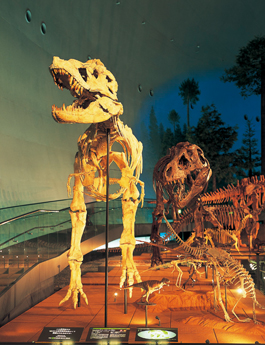
The Dinosaur Valley Fukui Katsuyama Geopark (Recognized as a geopark October 2009) is a geopark that encompasses the entire area of Katsuyama City in Fukui Prefecture. Starting in 1989, in Katsuyama City, Fukui Prefecture’s Dinosaur Fossil Excavation Survey Project has produced many dinosaur fossils of great scientific value. The discovery and restoration of complete skeletal structures of the Fukuiraptor and Fukuisaurus, as well as dinosaur eggs and fossils of developing dinosaurs, bring to light the conditions that dinosaurs lived in.
The theme of this geopark is, “Where were the dinosaurs? The movement of land: From the Eurasian continent to Katsuyama”, covers the era from when dinosaurs lived on the Eurasian continent to the discovery of dinosaur fossils in Katsuyama, including geological activity and heritage sites. Through this theme, the geopark also aims to have visitors gain an understanding of the peoples’ lives in the “region as a whole” through not only observation, but through first handed experience.
Within the geopark, there are also three other major themes: “Dinosaurs and Dinosaur Fossils”, “Volcanoes and Volcanic Activity” and “Kuzuryu River and topography.” Through these three themes, various geological heritage sites, ecosystems and cultural heritage sites in Katsuyama are included.
What is a Geopark?
A Geopark is an area designated by UNESCO which contains a number of geological heritage sites of particular importance, rarity or aesthetic appeal.
Through the dinosaur fossil excavation and research project conducted by Fukui Prefecture since 1989, researchers have succeeded in reconstructing full dinosaur skeletons and assign names to the Fukuiraptor and Fukuisaurus, discover many bones and footprints of young dinosaurs, and in general gain a better understanding of how dinosaurs in this region once lived.
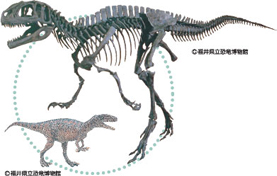
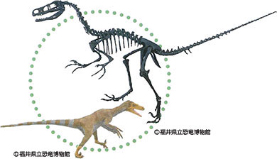
These dinosaurs, along with a complete skeleton of the Doromaeosaudidae reconstructed in March 2010, can be seen on display in the Fukui Prefectural Dinosaur Museum.
This 4.2 meter-long carnivorous dinosaur is believed to be related to the Carnosaur. Having discovered almost a complete set of hand and feet bones, the Fukui Raptor is the first complete skeleton of a carnivorous dinosaur to be reconstructed in Japan.
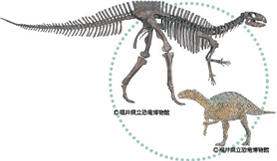
Fukuisaurus is a herbivorous dinosaur similar to Iguanodon. Enough number of individual bones have been found to allow the reconstruction of the 4.7 meter-long full body skeleton, which serves as a very important model in studying the evolution of Iguanodons.
The Fukuititan was the first Sauropod found in Japan to receive a Latin name,and it is closely to the Titanosaurus.Only a limited amount of the full skeleton has been discovered ,so there are still some details of the full body of this dinosaur that remain unknown.
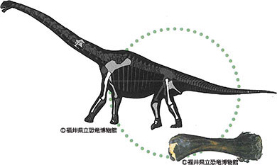
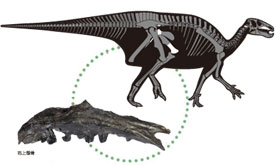
There is an Iguanodon type herbivore dinosaur that is similar to the Fukuisaurus whose name has a connection with Katsuyama. The plentiful environment of Fukui’s environment during the early Cretaceous Period is reflected through the coexistence of several types of herbivore dinosaurs.
Including part of the skull, 65% of the total skeletal body of Dromnaeosaurus has been identified.This small dinosaur was a carnivore that may also have had wings.it is expected that this is a new species.
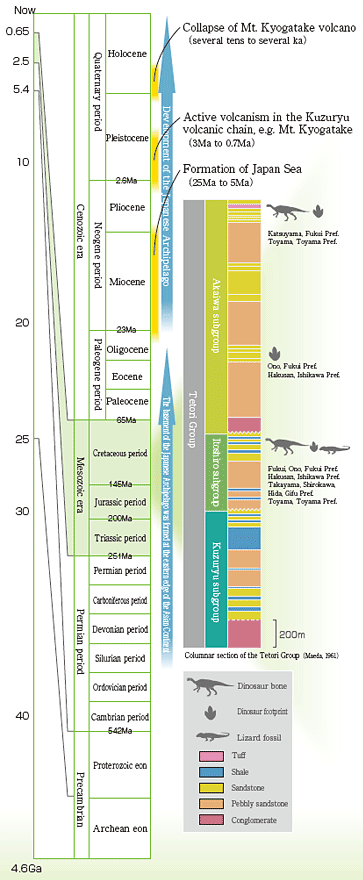
Mesozoic Tetori Group is a geologic stratum distributed throughout the Hokuriku Region (northwestern Honshu), and is known for its abundant dinosaur fossils. At the time when the Tetori Group deposited, the region was located on the eastern margin of the Asian continent. As the Tetori deposition environment changed from an inner bay to brackish water then to fresh water, dinosaurs and many other creatures thrived here.
Geological History of
Dinosaur Valley Fukui Katsuyama Geopark



Based in the forest around the Fukui Prefectural Dinosaur Museum, this course allows you to fully enjoy the wonders of the Dinosaur Kingdom through activities such as nature walks and the chance to dig up your own dinosaur fossils.
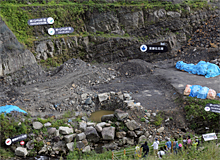
About 15 minutes away from the museum by car is the fossil excavation site, which features a cliff of geological stratum from the Cretaceous Period that is over 120 million years old. You can observe this 80-meter-high cliff from the hill on the opposite bank of the Sugiyama River.
※Please note: the forest road leading to the site is sometimes restricted to private vehicles, and is closed during the winter season.
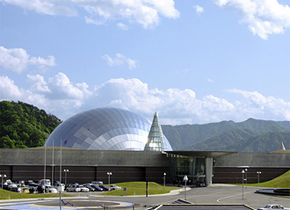
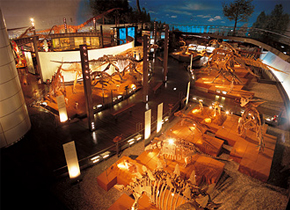
About forty skeletons of various dinosaurs are displayed in a vast exhibition hall called the “Dinosaur Dome.” The museum is one of the best natural history museums in Japan, attracting more than 700,000 visitors a year.
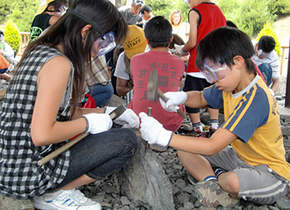
This fun opportunity to dig up your own fossils is organized by the NPO “Supporters of Katsuyama, the City of Dinosaurs,” and is very popular among children of all ages. Prior registration is needed to join the event.
※For details, please visit the following website (Japanese only): http://www.kyoryunomori.net/
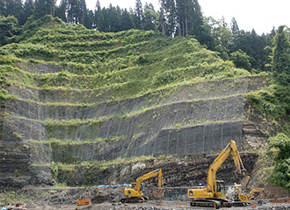
This excavation site is the number one in Japan in both its scale and in the amount of fossils uncovered. Many precious dinosaurs and other fossils found here have opened a new page in the study of dinosaurs in Japan. There is a nature trail leading to Meoto Falls that begins here as well.
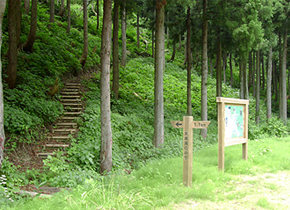

Starting the year-round resort Ski Jam Katsuyama, drive along the beautiful Houonji Forest Road toward Ono City is a great way to experience this group of geosites. There are many geologic points of interest around Mt. Kyogadake, including the quarternary volcano Mt. Houonji. In this course you can experience the beautiful nature in all seasons as well as breathtaking panoramic scenery of the region’s valleys and peaks. Rental bikes are available to enjoy cycling through the highlands, and there are many other activities and hiking courses to try.
※Please note: The forest roads have many sharp curves, so please use caution when driving. Roads may be inaccessible during severe weather or thick fog, and are closed for the duration of the winter season.
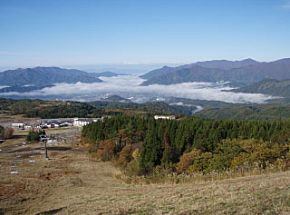
The resort is located on a lava plateau called Yoshinogahara.
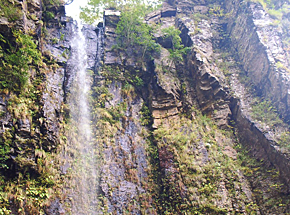
The waterfall is formed on lava flows.
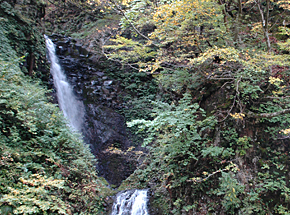
Around the waterfall you can see columnar joints which were formed by hardening of lava.
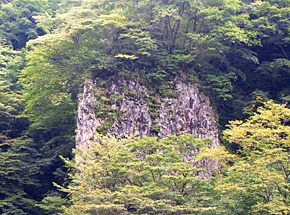
Columnar joints, which formed through thermal contraction while the erupted magma cooled and consolidated, can be observed at the outcrop locally called "Tsurigane-Iwa."
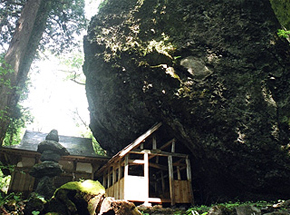
The giant boulder found in the grounds of the shrine ended up here after a rock avalanche caused by a sector collapse of Mt. Kyogadake.
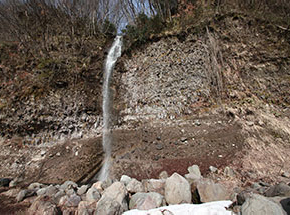
Kashigakabe Wall was formed by the accumulation of landslide debris following the collapse of Mt. Kyogatake’s mountain body.

Starting from Yume Ole Katsuyama Textile Factory Memorial Hall in the central part of the city, strolling through the peaceful streets of Katsuyama will take you back to the good old days of Japan. Rental bikes are also available. You can visit the Shichiri-Kabe wall and the Oshozu and Shozu springs, geological features which have been integrated into the townspeople’s everyday lives.
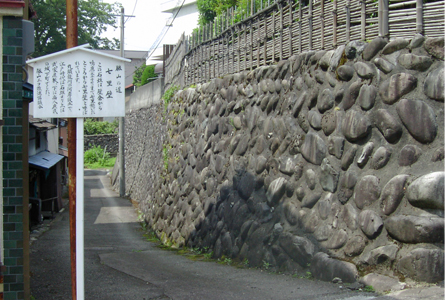
These stone walls are built in intervals along the terraced levels of the Kuzuryu river banks and stretch from central Katsuyama to Eiheiji-cho for more than 20 kilometers-7 ri. (Ri is a traditional unit of distance used in Japan before the metric system was adopted and is equal to about 4 kilometers). The wall represented the border of residential zones between the ruling samurai class and the subordinate merchant class during the Edo period.
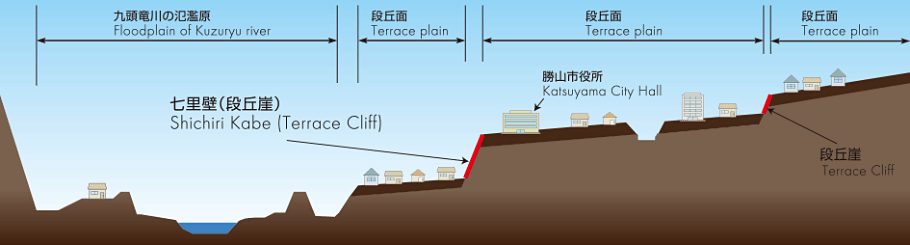
A cross-sectional view of river terrace within the Katsuyama City area
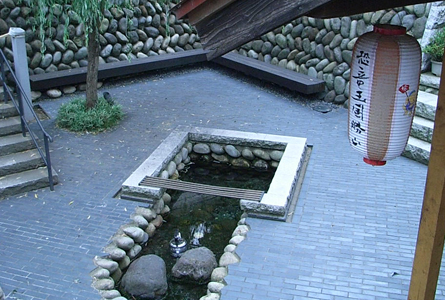
The structure of downtown Katsuyama City is a river terrace (a landform with multiple tiers), and river and rain water absorbed by the soil move from higher to lower terraces until finally flowing out of Oshozu Spring.
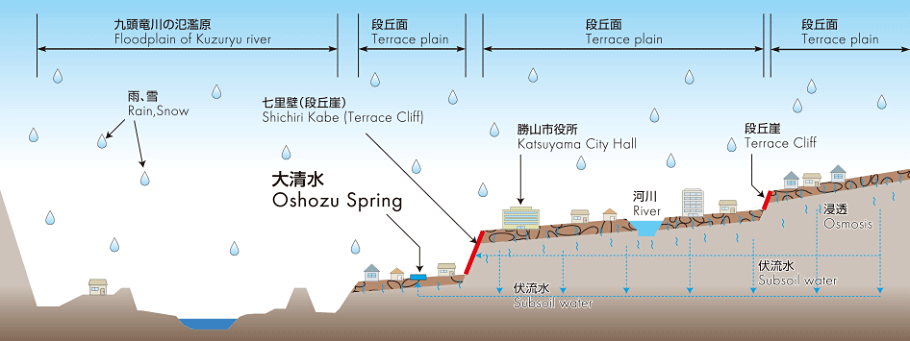
The flow of water to Oshozu Spring
Originally built in 1905, this textile factory was renovated into an experience-based museum where visitors can learn the history of the textile industry in the area as well as hand-weave coasters of their own design. The building was declared a national Heritage of Industrial Modernization site in 2008.
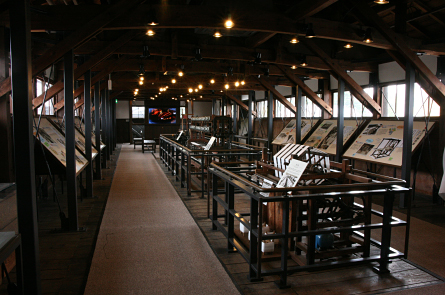
Textile machine exhibit
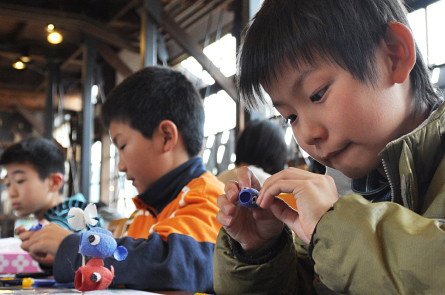
Craft-making experience
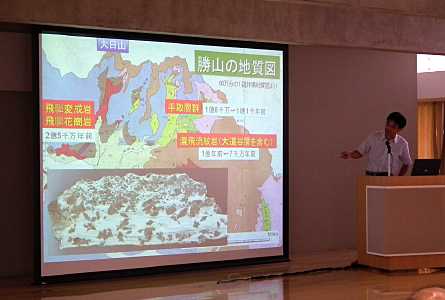
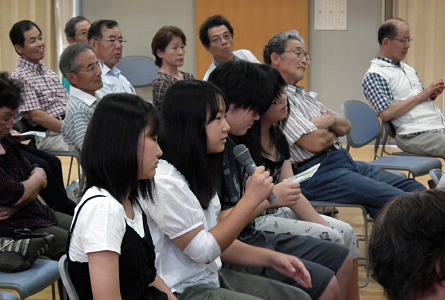
Citizens attend lectures taught by researchers and geopark staff members.
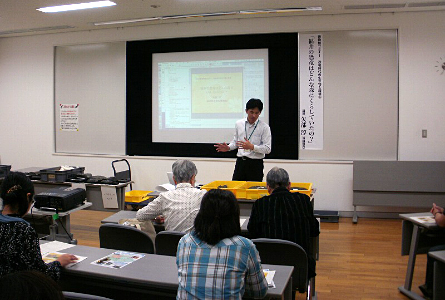
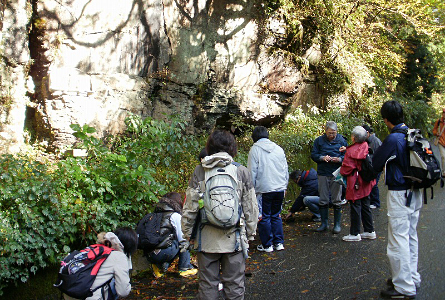
Citizens attend seminars and go on nature observation excursions to learn about the geopark.
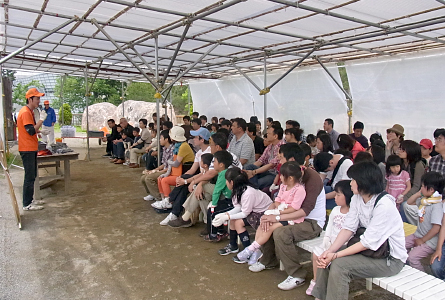
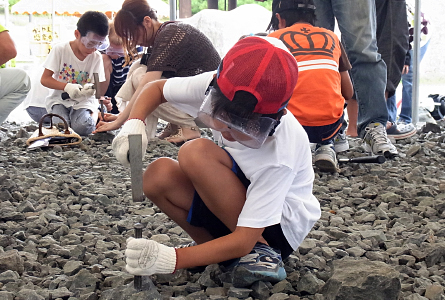
There is a fossil dig experience at Katsuyama Dinosaur Forest Park.
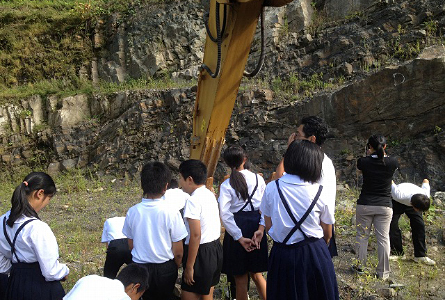
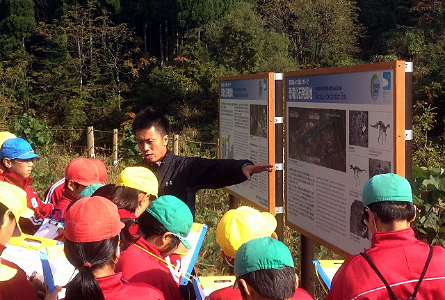
Students go on geopark field-study excursions.
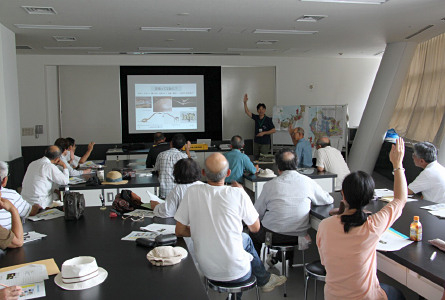
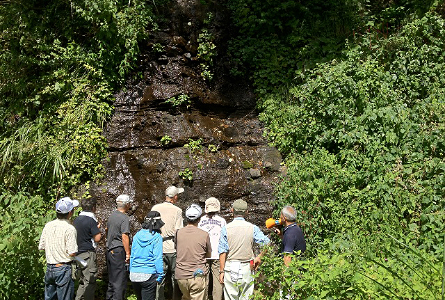
Geopark guides are trained to educate visitors about the region.
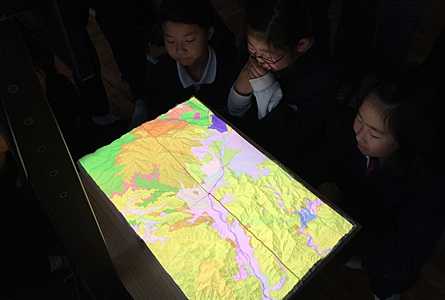
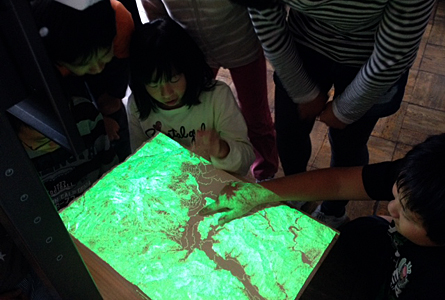
The precision three-dimensional geological model being used in the school curriculum.
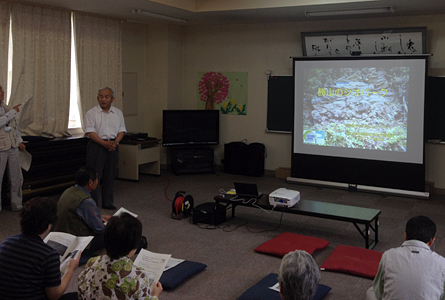
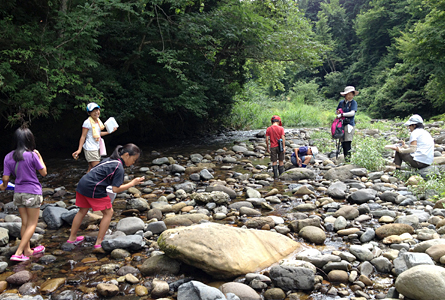
People of the region learning about Earth’s geological features and its effect on people’s lives.
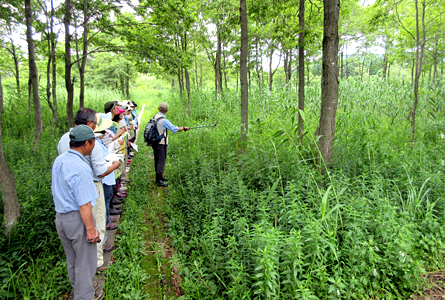
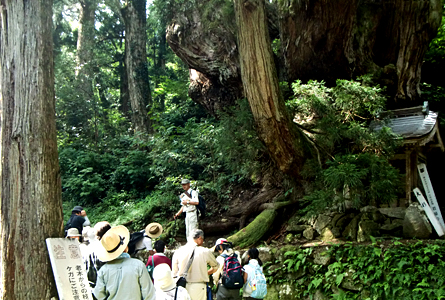
Nature observation instructors hold monthly observation events.
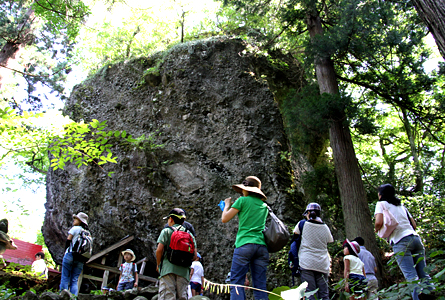
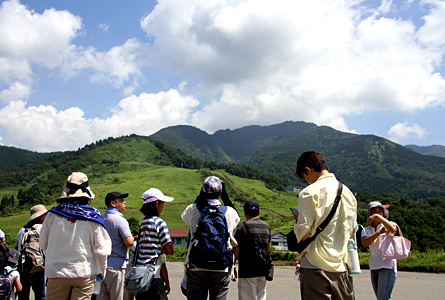
Through discussion by experts and those in the tourism sector (including tour guides), various geo-tours and eco-tours are planned and held.

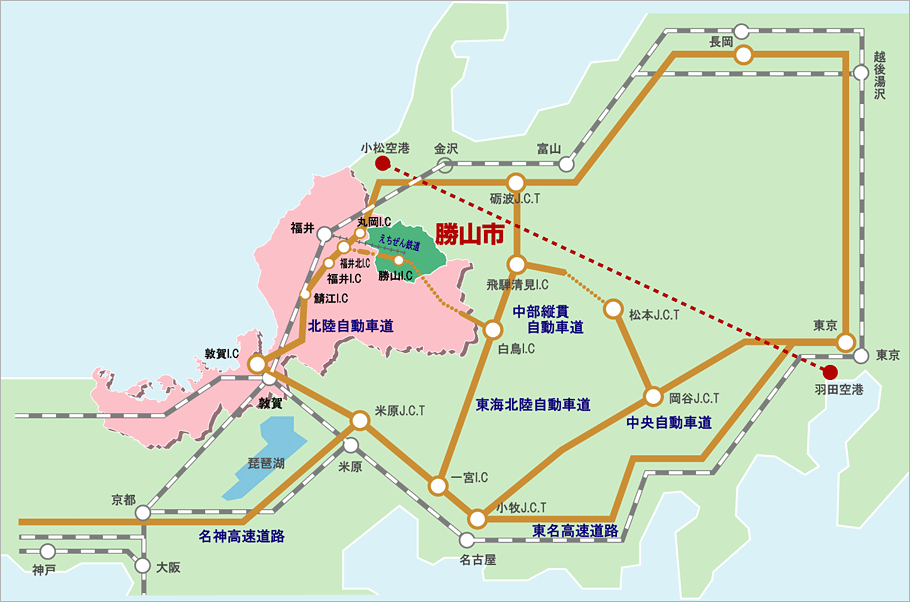
From Osaka→ (1hour 45minutes, special express, JR West) →Fukui→ (52minutes, Echizen Railway)→Katsuyama
From Nagoya→ (2hours, special express, JR Central & West) →Fukui→ (52minutes, Echizen Railway)→Katsuyama
From Tokyo→ (2hours 15minutes, bullet train, JR Central) →Maibara→ (1hour, special express, JR West) →Fukui→ (52minutes, Echizen Railway) → Katsuyama
From Komatsu Airport→ (69minutes, bus) →Fukui Station→ (52minutes, Echizen Railway)→Katsuyama
35 minutes drive via Route 416 from Fukui Kita IC or Maruoka IC of Hokuriku Expressway
60 minutes drive via Aburasaka Toge Road (tollway) and Route 158 from Shirotori IC
Katsuyama is a beautiful and quiet city built upon the river terraces along the Kuzuryu River. The area is also known for its heavy snowfalls, which fostered textile and brewing industries. In medieval times, the area thrived as a religious center with 48 shrines, 36 temples, and a population of over 6,000 monks, until it was destroyed by mobs of mainly Buddhist peasant farmers in 1574.
In the Dinosaur Valley Fukui Katsuyama Geopark, not only can you enjoy an exciting encounter with dinosaurs, but you can also learn how the geology and geomorphology have affected the history and culture of the region.
Fukui Prefectural Dinosaur Museum
c/o Katsuyama Dinosaur Forest Park, 51-11 Terao, Muroko-cho, Katsuyama City, Fukui Prefecture
TEL 0779-88-0001
Geopark Visitor Center
Katsuyama Dinosaur Forest Park
51-11 Terao, Muroko-cho, Katsuyama City, Fukui Prefecture
TEL 0779-88-8777
Ski Jam Katsuyama
(a year-round outdoor resort)
170-70 Katsuyama, Katsuyama City, Fukui Prefecture
TEL 0779-87-0081
National Historic Site Hakusan Heisenji
56-63 Heisenji, Heisenji-cho, Katsuyama City, Fukui Prefecture
TEL 0779-88-1591
Yume Ole Katsuyama Textile Factory Memorial Hall
1-40 Showa-machi, Katsuyama City, Fukui Prefecture
TEL 0779-87-1200
Katsuyama Castle Museum
85-26-1 Heisenji, Heisenji-cho, Katsuyama City, Fukui Prefecture
TEL 0779-88-6200
Medieval architectural remains and various articles of daily use have been excavated around this moss-covered tranquil shrine, which boasts a history of over 1,300 years.
Originally built in 1905, this textile factory was renovated into an experience-based museum where visitors can learn the history of the textile industry in the area as well as hand-weave coasters of their own design. The building was declared a national Heritage of Industrial Modernization site in 2008.
Echizen Daibutsu (Giant Buddha) / Seidaiji Buddhist Temple
50-1-1 Katase, Katsuyama City, Fukui Prefecture
TEL 0779-87-3300
You can visit most of the geosites mentioned in this brochure by car or bike (rental bicycles available), however, especially in some mountainous areas, access roads may be closed due to severe or winter weather. First-time visitors are recommended to join one of the various events such as geotours or guided walks held by Katsuyama City and the Dinosaur Museum.